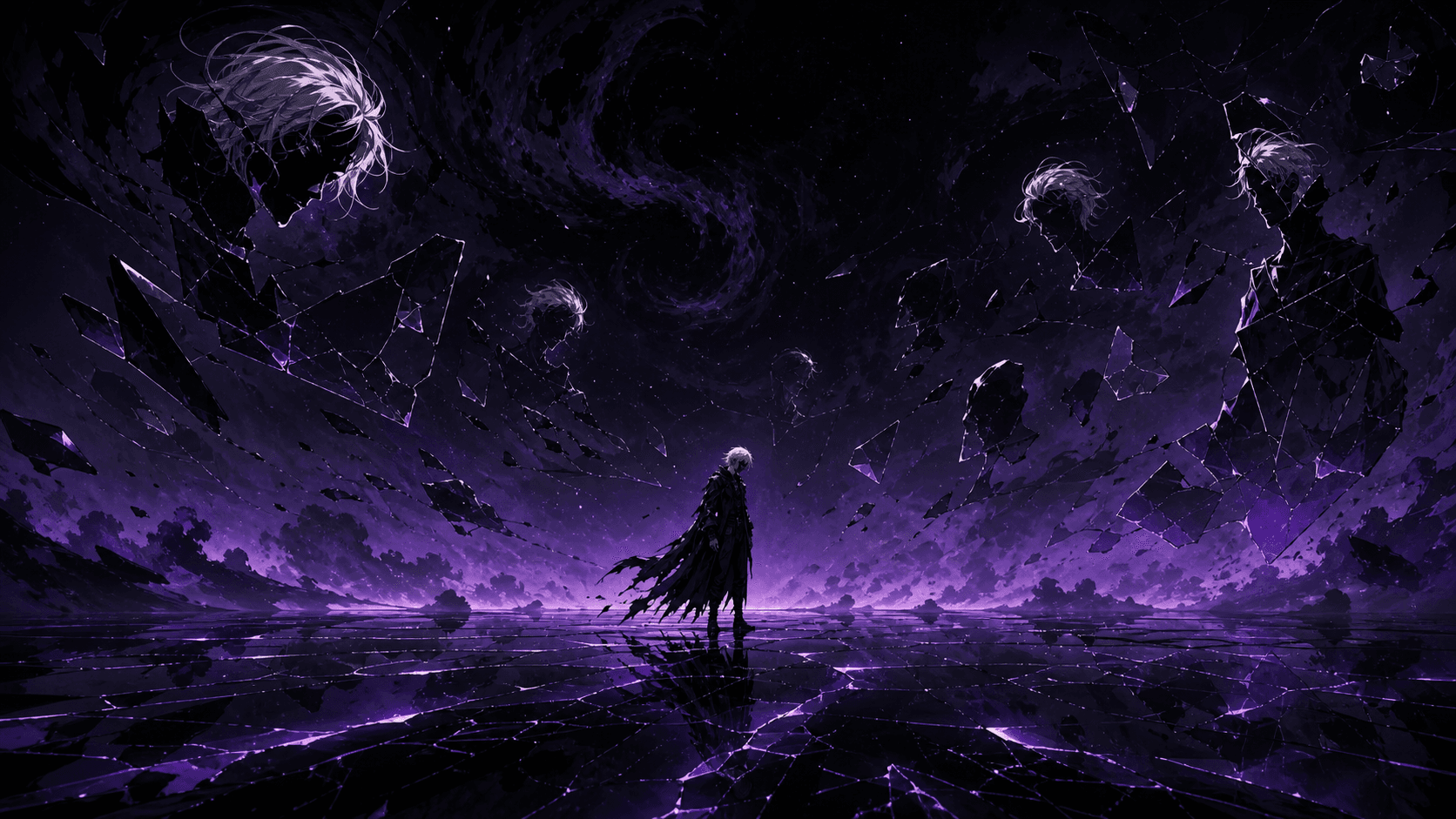
Kaelen Vyr: The Day the Child Was Cast into the Void
Before the Void took his name, Kaelen Vyr was a laughing child. This is the story of the Ache, the fire, the lynch mob — and the first child ever cast through the gate.
Type
origin
Character
Element
Region
Origin event
Kaelen Vyr had a name before he lost it.
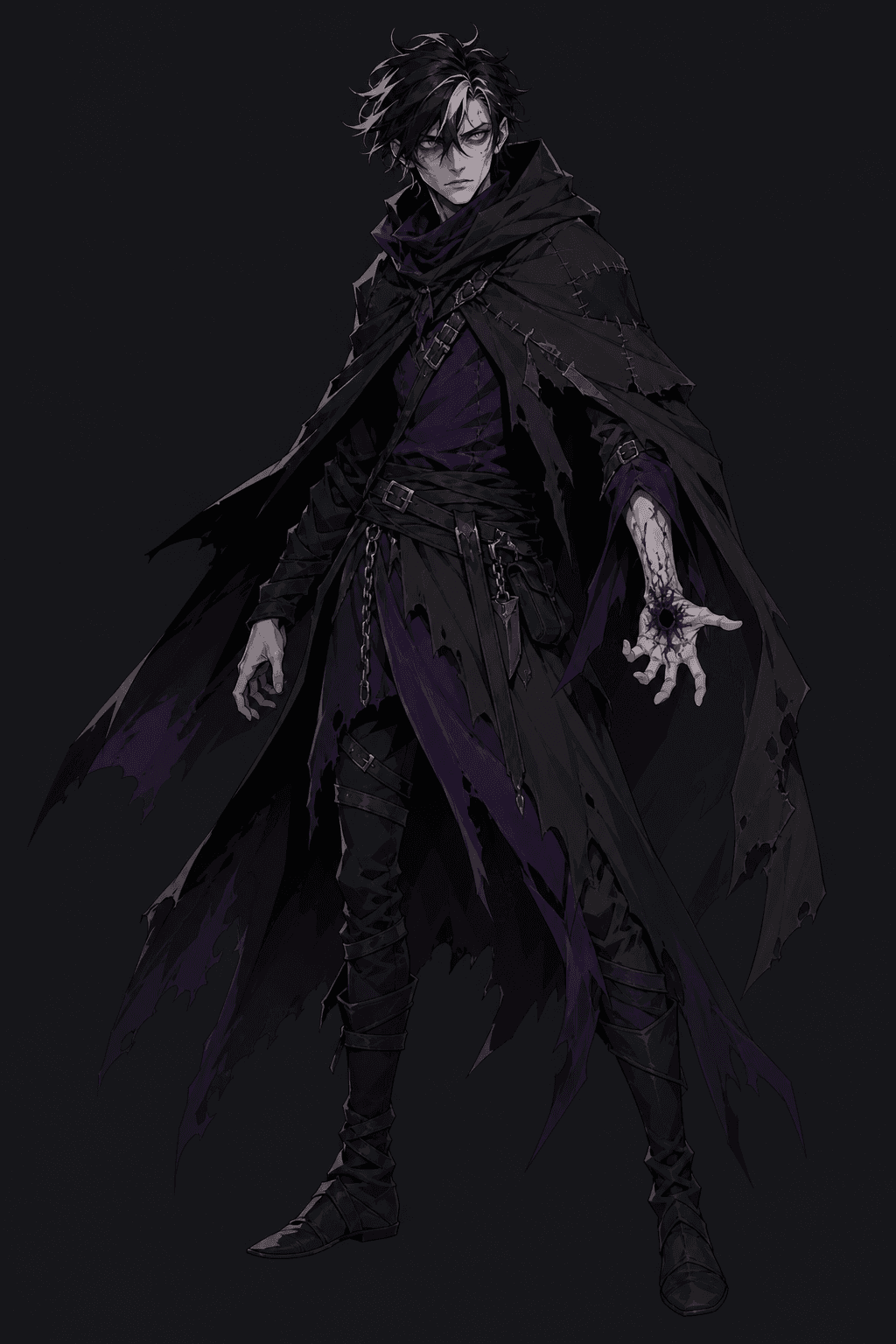
That sentence is truer than most of what is told about him. People remember Kaelen as the man who came back from the Void — the mark of absence on his left hand like an old burn, the way he stops in the middle of sentences, the way he looks at you as if he were still standing on the threshold of a door. But before that man, there was a boy. A boy who laughed too much, who climbed his father''s shoulders, who could smell his mother''s warm bread from the street, who skipped stones with his little sister by the river.
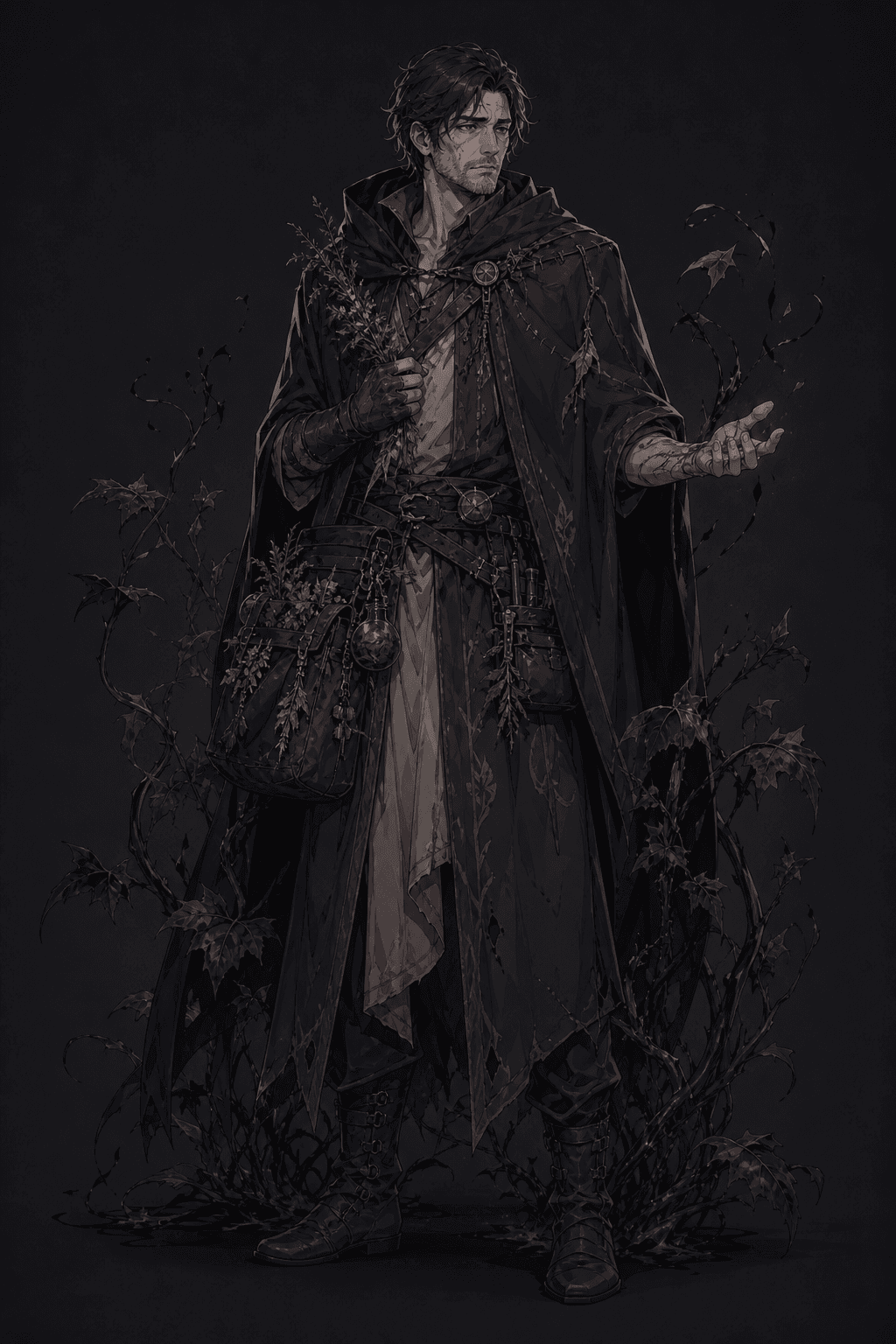
His father, Rovan Vyr, was a beloved man in the village. Not a card master, and certainly not a fighter. He knew plants. Which leaf breaks a fever, which root cuts pain, which mushroom turns poisonous in winter — he knew these things, and people came to him when they were sick. Rovan''s hands belonged to the soil; he handled even the things he picked as if apologizing to them.
Kaelen loved his father most in the evenings.
Because in the evenings Rovan would finish his work, sit at the small wooden table, and show Kaelen the seeds in his palm. "These are patient," he would say. "If the soil is right, they wait. If it''s wrong, they don''t insist. People are sometimes less wise than seeds."
Kaelen would laugh. Rovan would laugh. His sister Lira would join the laughter without understanding a word of it. Their mother Elen would set the soup on the table and say, "Your father is talking to his plants again."
In those years the Void Gates opened rarely. One would appear in the sky like a cut, and vanish a few hours later. The elders advised staying indoors on gate days. The stories told to children said the Void stole more than people — it stole names, memories, and smells.
No one knew what it did to plants.
Rovan was the first to notice.
The morning after a gate had opened, he saw that the yellow-veined grasses on the village''s north slope had changed. On the surface of the leaves lay a fine, ash-like violet dust. It did not mix into the soil. It did not wash away with water. When wiped off with a finger, it reappeared a moment later — as if it remembered to exist a little late.
Rovan first took it for a disease. Then he dried it. Then he boiled it. Then, by accident, he breathed its vapor.
He came home very quiet that day.
When Elen asked him what was wrong, he said: "There is no wind behind the gate."
At the time, the sentence meant nothing to anyone.
Rovan gave the new substance no name. To name it would have been to accept it. The village would later call it the Seep, because it was believed to seep into the world whenever a gate opened. Joined with plant matter it stopped being poison or medicine and became something else. It pretended to wake you while it quietly loosened the knots that hold reality together. Colors deepened. Sounds took on shapes. Shadows acquired intent. Faces turned into other beings.
Rovan used it, at first, to understand it.
Then to forget.
Then, on the days he did not use it, he began to feel that the world was incomplete.
Kaelen noticed the change but could not name it. His father''s laughter grew rare, and then began to arrive in the wrong places. One evening Lira spilled her soup and Rovan laughed. It lasted only a moment, but something settled into Kaelen — because the laugh resembled his father''s laugh, and was not his father''s.
By the time Elen found the dried plants Rovan had hidden, it was nearly over. She begged him. Rovan wept. He swore he would never use it again. Kaelen listened from behind the door and believed his father''s remorse was real.
Children are bad at knowing when their fathers lie. A father''s lie is a crack in one of the load-bearing columns of the world.
The last gate opened close to winter.
There were no stars that night. The dark that settled over the village was heavier than ordinary dark. Lamps burned in the windows, but the light seemed unwilling to leave the glass. When Kaelen rose from his bed, the house smelled sharply of bitter herbs.
He went down to the kitchen.
Rovan stood in the middle of the room. The old pruning knife was in his hand. His eyes were not on Kaelen; they were on something behind Kaelen.
Elen stood facing him. Lira clung to her mother''s skirt. Elen''s voice did not tremble, and so, at first, Kaelen was not afraid.
"Rovan," Elen said. "Look at us. It''s us."
Rovan shook his head slowly.
"You''re behind him," he said. "You''re standing behind the boy."
Kaelen understood nothing.
Years later, learning to survive in the Void, he would understand that some creatures wait in the places human eyes cannot see. But there was no creature in the kitchen that night. It existed only in Rovan''s mind. The Seep had dressed Elen and Lira in the shapes of Void things. Rovan did not see his family. He saw two creatures about to fall upon his son.
And he believed he stopped them.
For a long time Kaelen remembered that he did not scream that night. People said he screamed; he could not remember his own voice. The only thing he remembered was that his sister was still holding their mother''s skirt when she fell.
Then Rovan turned to him.
"Run," he said.
And walked toward him as he said it.
Kaelen did not run. His legs did not know how. There were two faces on his father at once: the face of the man trying to save him, and the face of a stranger looking at an enemy that had to die. The two fought inside the same body.
When the villagers broke down the door, Rovan was on top of Kaelen. The knife had fallen. Rovan was weeping. There were violet fingermarks on Kaelen''s throat.
The village did not kill Rovan Vyr.
In those days, killing was not considered mercy enough. Casting into the Void was the older, heavier sentence. When the gate opened, the seal masters chained Rovan. He did not look at Kaelen, not once, all the way to the threshold. He was afraid that if he looked, he would not know whether he was seeing his son or a monster.
Kaelen stayed in the village.
For a while, everyone claimed him. The women who had loved Elen brought him food. The elders patted his head. The village head declared, "This child is our trust." His teachers were gentle. People are good when grief is new. While the smell of it is still in the air, no one wants to look cruel.
But grief becomes invisible with time. The child remains.
Kaelen changed.
First he went quiet. Then he grew angry. Then his anger began hitting every wall like an animal that doesn''t know which door leads out. He attacked children at school for looking at him. He broke one boy''s nose. He pressed another''s hand to the stove. He pushed a boy down the stairs for mentioning his sister. He hated those who pitied him, and terrified those who feared him.
The village tried to understand him.
Then it got tired.
"His father''s blood," they began to say — first in whispers, then openly. "Nothing sound was ever coming out of that house anyway." The more Kaelen heard it, the harder he became. Everyone searched him for his father''s shadow. So he gave them shadow.
When he was sixteen, the school burned.
The fire started at midday break, on the old storeroom side. Dry timber caught fast; the wind carried the flames into the classrooms. Two children were trapped inside. No one could save them.
Kaelen was behind the school at the time, at the foot of the stone wall. Three people knew this: the boys who had started the fire. They had thought the flame was a game, and when it grew, they were afraid. But the village''s rage was looking for a face, and Kaelen''s face fit.
"We saw him," they said.
"He went into the storeroom."
"He always said he''d kill us."
Kaelen denied it. For the first time he did not rage — he simply told the truth. It was not enough for the village to believe him.
The village head objected. "He is a child," he said. "Whatever he has done, the Void sentence is not applied to children."
But that day there were two small coffins.
A village in mourning does not concern itself with justice. Mourning, sometimes, only wants someone to sacrifice.
The gate opened that evening.
They dragged Kaelen. The village head''s voice drowned in the crowd. Kaelen screamed, cursed, bit, kicked — he fought to the last step. But when they brought him before the Void Gate, he went silent.
Because there was no wind coming from behind it.
In that moment he understood the sentence his father had spoken years before. There is no wind behind the gates — because the world there has forgotten even how to move.
Kaelen Vyr became the first child ever cast into the Void.
And the last.
Three days later, one of the boys who had started the fire confessed. Then the other, weeping. No one in the village spoke loudly after that day. The village head had the ruling carved into the stone council record: no child would ever be sent to the Void again, for as long as the stone lasted.
But the gate had closed.
Kaelen was inside.
The Void did not kill him on the first day. Perhaps it considered that an insult. Things lived there — though "lived" is too warm a word for them. Kaelen learned to hide. To make no sound. To stay away from light. To avoid thinking his own name too often, because the Void followed certain thoughts the way animals follow scent.
He did not see his father for years.
But Rovan saw him.
In the Void, Rovan had regained part of his mind. There was no Seep there. No plants. No visions. Only the whole of what he had done. Elen''s face. Lira''s hand. The bruises on Kaelen''s throat. Rovan''s punishment was not the Void; the Void was merely the place keeping him alive. The true punishment was remembering.
He watched his son from a distance. He never showed himself. He believed he had no right to. On some nights — if the things there could be called nights — he drew away the creatures that passed too close to the crack where Kaelen hid. He left food-like things where the boy would find them. He erased certain card traces. Kaelen took these for the Void''s strange mercies.
One day the mercy ran out.
A small but hungry thing of the Orvath line found Kaelen''s trail. Kaelen ran, hid, used a card, failed. The creature pinned him to the ground with claws that were less flesh than absence. Kaelen understood that he was going to die, and was surprised by how much like relief it felt.
Then Rovan appeared.
Kaelen did not recognize him at once. The Void thins people; it takes from their faces the parts that were never truly theirs. But a child does not need a face to know his father. The slope of the shoulders is enough. The silence before a voice begins is enough.
"You," Kaelen said.
Rovan did not answer.
Because to answer would be to ask forgiveness, and to ask forgiveness would give Kaelen the burden of hearing it. Rovan did not believe he deserved even that.
He knew the creature''s weakness. Years of surviving the Void teach a person things. Beneath the being''s neck there was a knot — the place where it was tied to reality. Rovan leapt for it, and drew a card Kaelen had never seen before.
The seal on it did not look like anything made by human hands.
When Rovan used the card, no light came out.
The light went out.
For one instant, even the Void recoiled. Then the creature''s body collapsed inward, and Rovan collapsed with it. The two of them came apart inside the same absence.
What remained was Rovan''s deck.
And a word Kaelen could not say.
Father.
Kaelen took the deck. He used it first to survive. Then to understand. Then to hate. Every card reminded him that his father had been both his family''s killer and his own shield. He thought of the village that had thrown a child to his death and then, in its remorse, passed a law. Remorse did not bring back the dead. The law was written after the gate had closed.
By the time Seran Null found him, Kaelen was no longer a child.
But the child was still in there. It had only hidden deeper.
Seran did not pity him. That is why Kaelen listened.
"You don''t have to forgive what they did to you," Seran said. "You don''t have to understand your father either. But you should see one thing clearly: the world believes it is good because it gives its punishments to someone else."
Kaelen did not answer.
Seran smiled.
"They threw you into the Void," Seran said. "The Void didn''t kill you. So that is not where you belong. So you stayed in order to bring something back out."
Rovan Vyr had kept his distance from the Void Cult all his life — because he knew that what happened to him was not fate but his own choice, and he refused to turn his own guilt into a doctrine.
But Kaelen carried no guilt.
Only rage.
And that was the thing Seran Null knew best: guilt pulls a person inward. Rage makes them walk.
Kaelen did not join the Cult that day.
He only walked after Seran.
Sometimes a person''s fall begins exactly like that — not with a great oath, but with one quiet step taken behind the wrong person.
Related records
Signals from this file

Inline portals