Mireth Sol: The Night the Crystals Wept
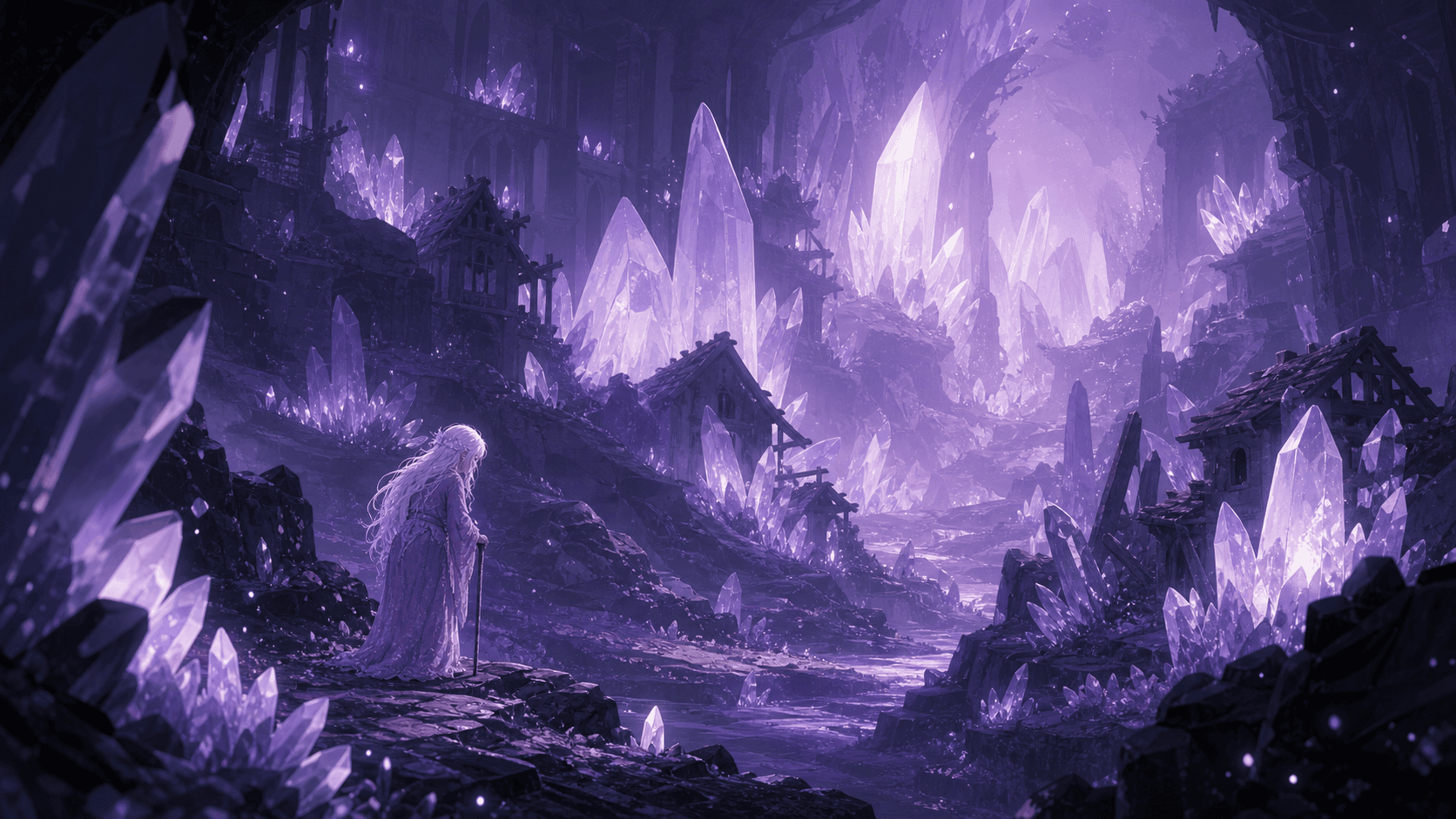
Blinded by the Crystal Scream, Mireth Sol stayed with the crystals for eighty years — until the night looters came, and the crystals wept for her.
Type
origin
Character
Element
Region
Origin event
Mireth Sol was eighty years old when she realized she was beginning to forget the sound of the human voice.
The sentence sounds impossible. How does a person forget the voice of her own kind? A mother calling a name, a child''s laughter, two neighbors arguing in the market, the sleepy tone of a man asking for bread in the morning — how are these lost?
Mireth did not lose them.
The crystals covered them over.
When she was a child, the village of Elyndra was where music lived. Every house held an instrument — some strung, some blown, some strange devices played with thin rods carved from crystal. The people of Elyndra knew how to cut stone, how to work crystal, and how to listen to an echo. Children learned to keep rhythm before they learned to speak.
Mireth had the finest ear in the village.
Her mother said so without pride — with a little fear. "This child doesn''t hear," she would say. "She sees the sound inside things."
Mireth could close her eyes and find the finest crack in her father''s old bowed instrument. She could tell which shelf a crystal glass stood on by the faint tremor it gave off across the room. She could hear the rhythm of water moving under the earth before the rain began.
Then came the Crystal Scream.
No one could ever say afterward exactly what it was. Some said the crystal vein beneath the earth had woken. Some said a card experiment had triggered the wrong frequency. Some said Elyndra had been built on a song all along, and the song had finally changed its note.
What Mireth remembered was the sound.
At first, it was beautiful.
The first note rising from beneath the village was so clear it made you believe the sky was made of glass. People came outside. Some wept. Some knelt. Mireth, with a child''s mind, thought this was not a catastrophe at all — the world was introducing itself.
Then the note climbed.
Glass burst. Animals fled. People covered their ears, but the sound did not enter through ears. It entered through bone, through teeth, through the spine. Crystals began to grow out of the ground. They split the walls of houses, cut roads in half, rose out of the well. Every crystal sang a different pain of the same song.
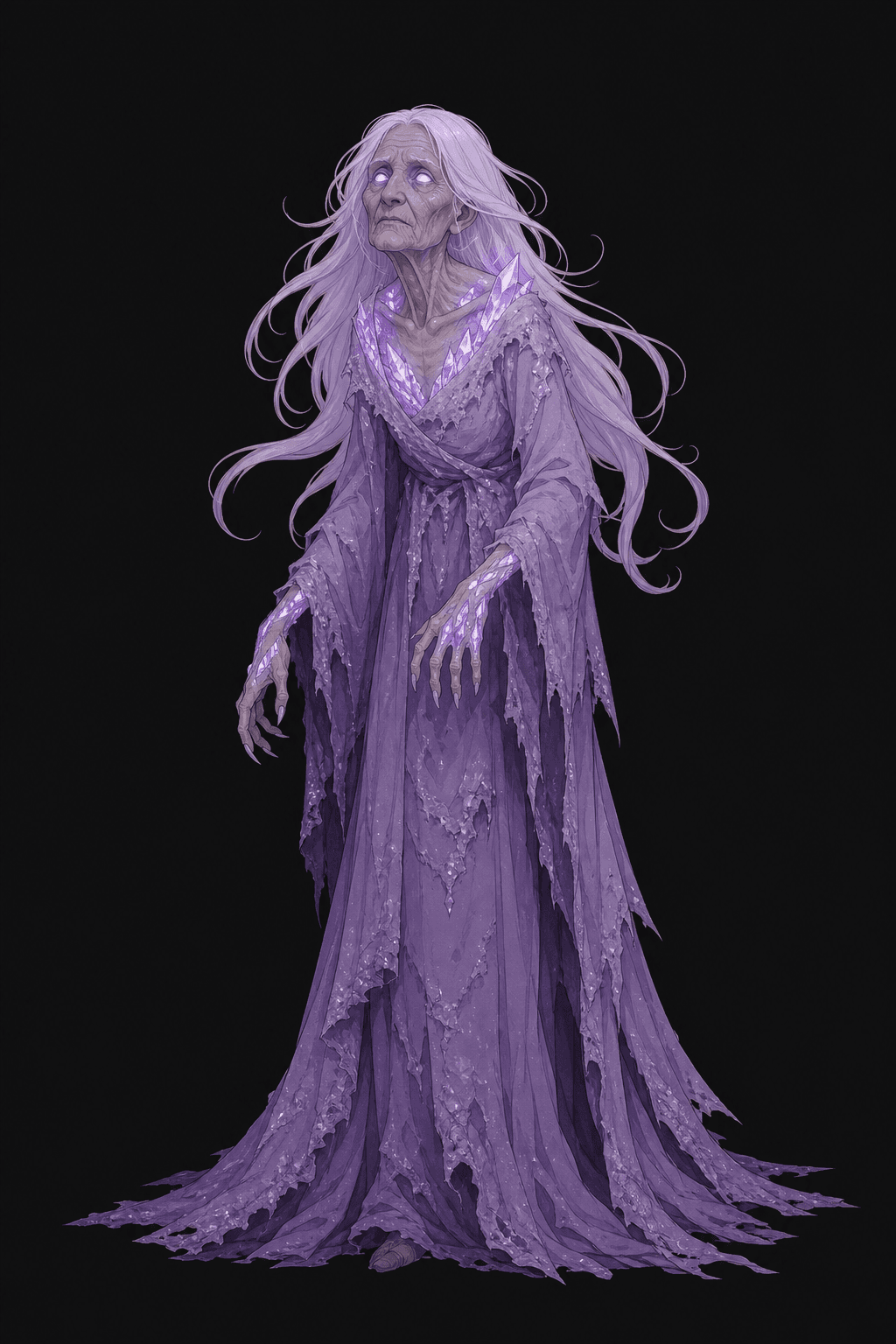
Mireth''s eyes turned white that day.
She did not go blind; the world became too loud to be seen. Her eyes simply stopped being useful. But the sound waves gave her lines sharper than any wall. She saw people''s bodies as vibration. Fear was a fast, broken beating. Death was a sound stopping mid-note.
Her mother''s sound stopped.
Then her father''s.
Mireth saw it happen.
Not with her eyes.
With something worse.
The few who survived fled the village. Some tried to take Mireth with them. They shouted at her, took her hands, tried to drag her. But she could no longer bear their voices. The human voice was broken, ragged, panicked; every word flew through the air like a sharp-edged stone.
The crystals were in pain too — but their pain was orderly.
Their pain could be predicted.
And to a child, predictable pain can feel safer than love.
Mireth did not go.
Eventually, the people let her stay.
Perhaps they thought she would die. Perhaps they promised themselves they would come back for her, and never could. Perhaps, in order to carry their own survivor''s guilt, they needed to be able to say: "She didn''t want to come."
For years, Mireth did not notice any of this.
Because loneliness is not a thing that arrives all at once. Especially not when everything around you is always singing.
She learned to speak with the crystals. Not with words — speech happened through touch. She would lay a fingertip against a surface and give it the smallest rhythm, and the crystal would answer. Some remembered old rains. Some remembered the pressure deep under the ground. Some remembered people''s last moments. Mireth listened to all of them.
No one saw her pass from childhood into old age.
Her hair whitened. Then crystal dust gathered in the white. Half-translucent growths formed under her fingers. Thin crystal veins appeared around her neck. Her eyes turned fully to crystal-white. But Mireth did not feel old. She had forgotten how to track time in human faces. She knew the seasons by the humidity shifting in the crystals'' frequency.
Animals did not come to the village.
Birds did not fly over it. Wolves went around it. People had long since erased the road to Elyndra from their maps — because to outsiders the crystal sound was not beautiful. To them it was a fingernail against stone, a cold passing through the teeth, a voice whispering your name while you sleep.
To Mireth, it was home.
In her eightieth year, the human voice came back to the village.
She took it for a tremor at first. Then she noticed the irregularity of footsteps. Three people. Perhaps four. Heavy packs, metal tools, leather straps. Their breathing was not fast; they were not afraid.
That frightened Mireth.
A frightened person is careful.
These were greedy.
They approached the crystals. Mireth stood inside her house, beside her old bed, listening. The words were hard for her — the edges of human language had rusted in her mind. But she understood the intent. She saw, in vibration, the position the tools took as they were raised toward the crystal.
The first blow fell.
The village groaned.
Mireth''s whole body went rigid. The crystal''s cry of pain was like hearing the bone of a friend break — a friend who had spoken with her for eighty years. The second blow came. The third. The people laughed. Mireth remembered that sound: the small, ugly sound of triumph people make when they believe a thing belongs to them.
She had forgotten it.
She had forgotten that people could be this greedy.
Remembering it weighed more than the catastrophe itself had.
Mireth began to weep.
It was not ordinary weeping. No tears came from her eyes — her eyes had been crystal for a long time. But the tremor rising from her chest passed into the floor. From the floor into the crystals. From the crystals into the great vein beneath the village. Mireth''s grief found the same frequency as Elyndra''s eighty years of grief.
The crystals changed color.
The violet-white light faded, then deepened, then sharpened past what a human eye can hold. The looters did not understand what was happening. The tools stopped in the air.
Then the crystals wept.
The sound was not a scream — scream is too human a word. It was more like the world correcting itself at a single point. The frequency turned only toward those people. No stone broke. No house fell. Not even the dust was disturbed. But the bodies that had come to break the crystal could not withstand the vibration inside their own matter.
For a moment they were there.
Then they came apart into very small pieces.
When the silence returned, Mireth was still weeping.
But not from fear anymore. From remembering. She had remembered the sound of people. Her mother''s last breath. The snapping string of her father''s instrument. The panic of those who fled. The hands that had let go of her. And worst of all — the beautiful crystal song that had covered all of it over.
Mireth walked to her house.
She lay down on the floor.
The place where she had slept as a child was cold as stone now. But the crystals slowly joined her. This time their song was not beautiful. It was not trying to be. It was simply staying beside her.
Mireth wept until her body could no longer carry the sound.
The last thing she heard before consciousness left her was the oldest crystal beneath the village, answering her on a very low frequency.
Translated into human language, it might have been:
"We are here."
Mireth slept.
And for the first time in eighty years, Elyndra kept the watch for her.
Related records
Signals from this file

Inline portals